
Necessary cookies help make a website usable by enabling basic functions like page navigation and access to secure areas of the website. The website cannot function properly without these cookies.
E-commerce Chatbots: The Complete Guide for 2026
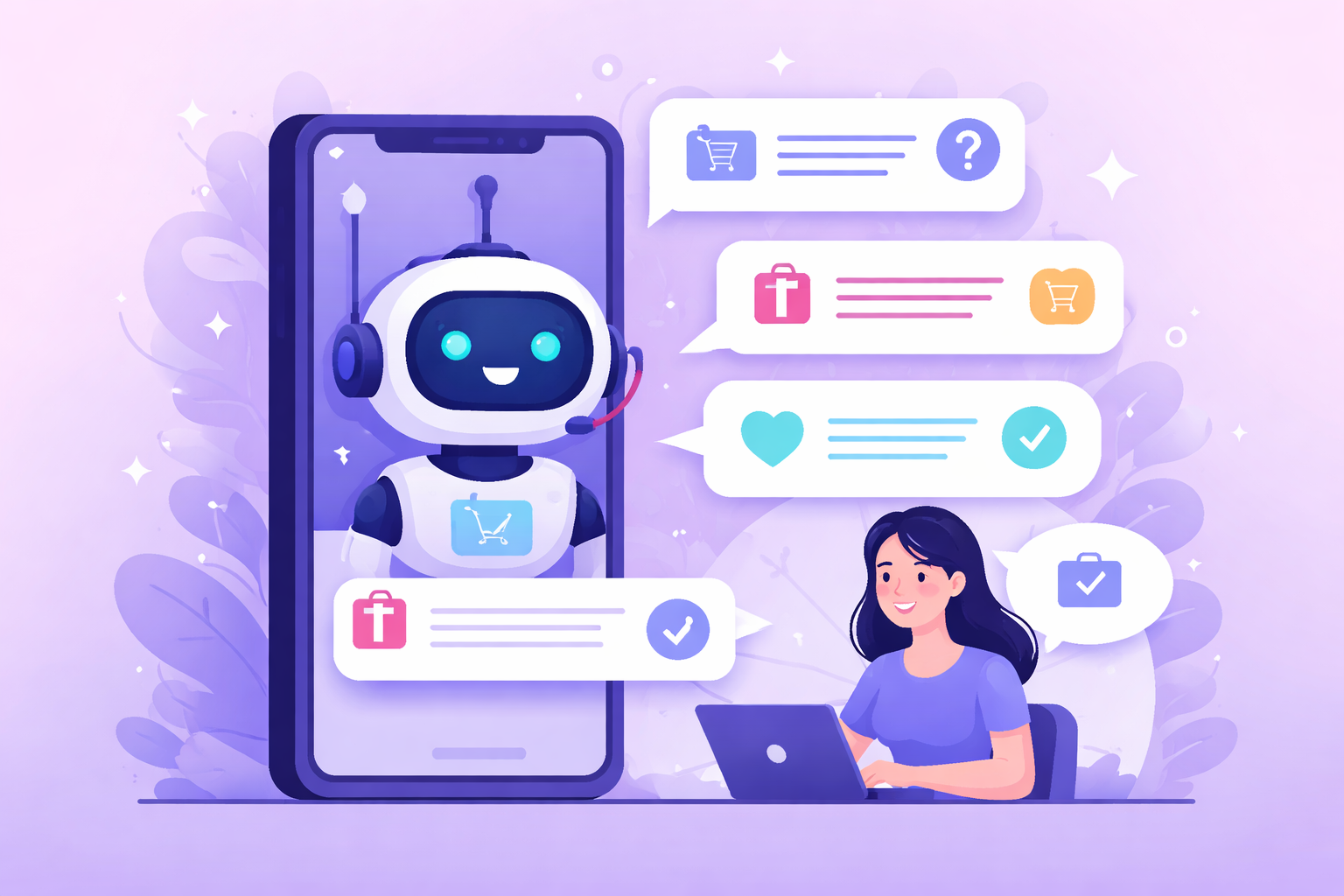
It is already 2026, and you still don't have the most helpful, instant, and personalized experience exactly when the customer needs it? Well, you might not be able to compete in the market anymore. And that is precisely why you need ecommerce chatbots.
An ecommerce chatbot is essentially an AI-powered conversational assistant that interacts with online shoppers through chat interfaces. It helps them discover products, compare options, ask questions, solve issues, and even complete purchases, all in one continuous conversation. Instead of clicking through endless menu options or waiting for a support agent, customers simply ask, and the chatbot gets to work.
And here’s why it matters so much in 2026:
Artificial Intelligence has grown up. A lot.
The chatbots people remember from a few years ago (the ones that couldn’t understand anything beyond a few rigid buttons) are basically “prehistoric” compared to what we have now. Thanks to modern Large Language Models (LLMs) and advanced conversational AI, ecommerce chatbots can:
- Understand customer intent (even if the question is phrased in a messy, human way)
- Personalize responses based on context and customer profiles
- Guide workflows like returns, exchanges, order tracking, product recommendations, and more
- Engage customers proactively, not just reactively
This shift from scripted bots to intelligent conversational systems has turned ecommerce chatbots into a core part of the online shopping experience.
In other words:
Ecommerce chatbots aren’t just answering questions anymore. They’re driving conversions, building brand loyalty, and quietly becoming one of the most important growth engines in modern online retail.
What Is an Ecommerce Chatbot?
At its simplest, an ecommerce chatbot is a software tool that helps online stores via a chat interface. It can answer questions, recommend products, track orders, process transactions, and guide customers through their shopping journey, all through natural conversation.
But within this definition, there are two very different types of chatbots:
Rule-Based Chatbots (Traditional)
These rely on fixed scripts and pre-programmed flows.
They can only handle specific questions they’ve been manually trained on (“Where is my order?”, “What’s your return policy?”).
If a customer asks something unexpected, they usually get confused, and this is what customers don't like.
AI-Powered Chatbots (Modern)
These use NLP (Natural Language Processing) and LLMs (large language models) to understand intent, sentiment, and context with advanced machine learning.
Chatbots can handle complex questions. They carry natural conversations. They adapt to different situations like a human support agent. They do this faster and are always available.
Why Ecommerce Chatbots Are Essential for Online Business
- 24/7 customer support: reduces wait times and support costs.
- Increase sales & conversions: through product recommendations & proactive customer engagement (e.g., cart abandonment).
- Scalability: handle thousands of chats simultaneously.
- Data & insights: track common queries to improve CX.
According to research, companies using AI-driven chatbots experience an average 25% increase in customer retention and 15% rise in revenue growth.
Top Ecommerce Chatbot Use Cases
- Instant support and customer service: Automate FAQs, policies, product availability, basic customer queries, and troubleshooting
- Product suggestions & discovery: Ask about preferences, personalized recommendations, and adjust suggestions dynamically
- Order management & tracking: Track shipping updates, check order status
- Lead generation: Engage with website visitors
- Cart abandonment recovery: Re-engage with customers
Proactive approach conversations can result in 35% recovery rates.
Examples of Ecommerce Chatbots in Action
Sephora – Virtual assistant for product find & selection
Sephora was one of the early adopters of ecommerce chatbots, launching its Sephora Virtual Artist chatbot to bring personalized beauty assistance online. This chatbot goes far beyond simple FAQs by:
- Interacts with users to offer tailored beauty advice
- Lets customers try on makeup virtually using augmented reality and image analysis
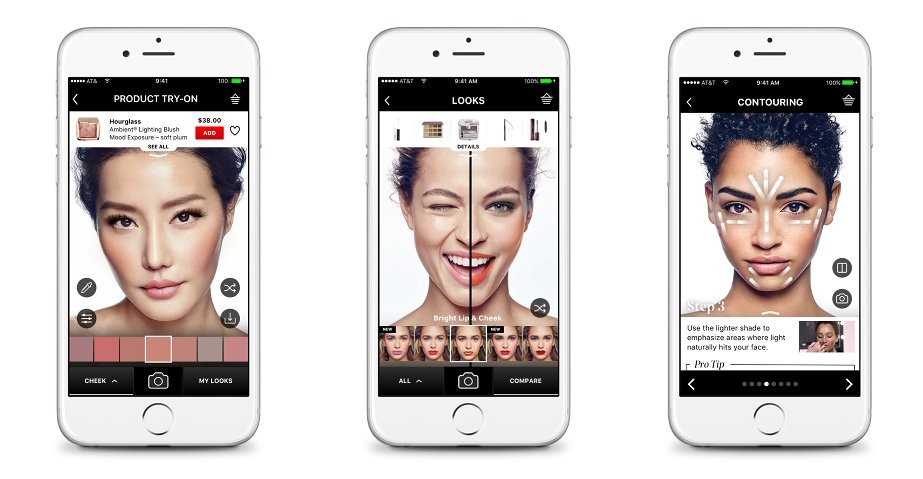
- Provides product recommendations based on preferences and skin type
- Links directly to products for conversion rates and even helps book in-store appointments
LEGO – Tailored Recommendations for Simplified Gift Shopping
LEGO’s chatbot, known through seasonal campaigns and integrated on messaging platforms like Facebook Messenger, helps customers choose the perfect gift by asking simple questions about:
- Who the gift is for
- Their age
- Interests and themes (e.g., superheroes, space)
- Budget constraints
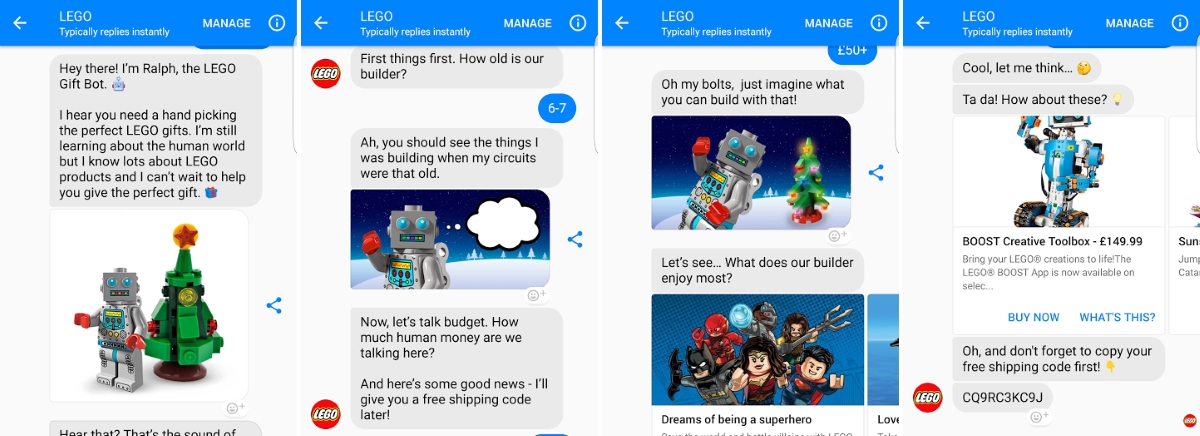
Based on the responses, the chatbot suggests relevant LEGO sets that fit the criteria. This guided discovery cuts through choice overload, especially valuable during busy gifting seasons, and has been shown to lower customer acquisition costs and improve return on ad spend.
Shopify - Drive checkout and engagement
Shopify’s ecosystem supports a variety of ecommerce chatbots that help merchants turn conversations into conversions. For example:
- Some chatbots integrated with Shopify can understand complex customer queries, recommend relevant products based on inventory and customer behavior, and even facilitate checkout directly in the chat interface.
- Shopify merchants using advanced conversational assistants report significant improvements in average order value and conversion rates, with some reporting 35% higher conversions.
Read More: Best AI chatbots for Shopify.
Ecommerce Chatbot Tools & Platforms
There’s no shortage of AI chatbots on the market, but not all of them are built for the same job.
Some focus on basic customer support and tickets, others on multichannel inboxes, and a smaller group on AI-driven automation and sales conversations. Instead of diving deep into each platform here, the table below gives you a high-level overview of the most popular ecommerce chatbot tools, grouped by category.
For a full breakdown of all 24 tools, including pros, cons, pricing, and best use cases, check out our detailed comparison guide.
| Tool | Best For | AI Level | Ecommerce Strength | Ideal Team Size |
|---|---|---|---|---|
| Re:amaze | Omnichannel support inbox | Rule-based | FAQs, WISMO, order tracking | Small–Mid |
| Tidio | Plug-and-play live chat | Basic AI | FAQs, handoff to agents | Small |
| Gorgias | High-volume ecommerce support | Limited AI | Deep Shopify actions (refunds, edits) | Mid–Large |
| Intercom | Support + marketing automation | Advanced (GPT-powered) | Behavior-based messaging | Mid–Enterprise |
| LivePerson | Enterprise conversational AI | Advanced AI | Complex flows, orchestration | Enterprise |
| SleekFlow | Messaging-first commerce | Rule-based | WhatsApp & IG selling | Mid |
| Olark | Simple live chat | None | Human-first support | Small |
| Zowie | AI support automation | Strong AI | Ticket deflection, multilingual | Mid–Enterprise |
| Kommunicate | Budget omnichannel chat | Basic AI | Human + bot hybrid | Small |
| HubSpot Chatbot | CRM-based lead qualification | Rule-based | Pre-sales routing | Mid |
| Zoho SalesIQ | Chat + analytics | Low AI | CRM-linked chat | Small–Mid |
| Shopify Inbox | Free Shopify live chat | Minimal AI | Native Shopify messaging | Small |
| Botpress | Custom AI chatbot builds | Advanced (dev-led) | Custom logic & workflows | Tech teams |
| Ada | Enterprise support automation | Advanced AI | Multilingual, omnichannel | Enterprise |
| Freshdesk / Freshchat | Support-first teams | Scripted AI | Helpdesk + chat | Mid |
| Zendesk | Large-scale support ops | Limited AI | Ticketing + help center | Large |
| AMIO | AI-native ecommerce chat | Advanced AI | Product + order automation | Mid |
| Heyday | Social + web chat | Medium AI | Shopify-native automation | Mid–Enterprise |
| HelpCrunch | Intercom-lite setup | Rule-based | Proactive messages | Small |
How to Choose the Right Tool For Your Online Store (Quick Tip)
- If your goal is to reduce support tickets, look at tools like Gorgias, Zowie, or Amio
- If you sell heavily via social media, tools like SleekFlow, or Heyday shine
- If you want true AI-driven conversations, focus on Zowie, Amio, or Ada
- If you just need something fast and simple, Tidio, Shopify Inbox, or Olark are more than enough
Best Practices for Implementing Ecommerce Chatbots
An AI chatbot’s impact depends less on the tool you choose and more on how you use it. These best practices help ecommerce brands get real results without overcomplicating things.
Start With One Clear Goal
Don’t try to automate everything at once. Pick a primary objective first:
- Reduce WISMO tickets
- Increase conversions
- Recover abandoned carts
- Automate returns
Build around that goal, then expand.
Deploy AI Chatbots at High-Intent Touchpoints
Chatbots work best where customers hesitate or ask questions:
- Product pages
- Cart and checkout
- Order tracking and returns
Avoid random pop-ups that interrupt browsing.
Keep Conversations Short and Helpful
Good ecommerce chatbots:
- Ask simple questions
- Use quick replies when possible
- Give clear next steps
If it feels pushy or confusing, it won’t convert.
Always Offer a Human Handoff
Let customers switch to a human when needed, and pass the full context along. AI should assist support teams, not block them.
Connect the AI chatbot to Real Data
Integrate product feeds, order systems, and shipping data. Static answers limit value; real-time data unlocks trust and automation.
Review and Improve Regularly
Check unanswered questions, failed flows, and drop-offs. The best-performing chatbots evolve with customer behavior.
And don't forget to get in touch in case you need any help in this journey.
FAQ Section
Do ecommerce chatbots really increase sales?
Yes. When used correctly, ecommerce chatbots can increase conversions. They help with product discovery. They answer pre-purchase questions. They also recover abandoned carts. Personalized recommendations and real-time support play a major role.
Are ecommerce chatbots better than live chat?
They serve different purposes. Chatbots handle repetitive, high-volume questions instantly, while live agents are better for complex or emotional issues. The best setups combine both, with smooth handoffs to human support.
Can chatbots handle order tracking and returns?
Yes. Many ecommerce chatbots integrate directly with platforms like Shopify or WooCommerce to provide real-time order status, initiate returns, and answer post-purchase questions without human intervention.
Do I need AI, or is a rule-based chatbot enough?
Rule-based chatbots work well for FAQs and simple workflows. AI-powered chatbots are better for understanding natural language, personalizing recommendations, and handling more complex conversations.
How hard is it to set up an ecommerce chatbot?
It depends on the tool. Some chatbots are plug-and-play and can be live in hours, while others require integrations and ongoing optimization. Most ecommerce platforms offer native or low-code options.
Are ecommerce chatbots expensive?
Costs vary widely. Some tools are free or low-cost for small stores, while advanced AI solutions are priced for mid-to-enterprise brands. The ROI often comes from reduced support costs and higher conversions. You can use our ROI calculator to see how much you can save on support costs and grow revenue with AI.
Table of Contents
Start building AI chatbots with Amio.
Book a 30-minute session where we will find out how AI bot can help you decrease call center costs, increase online conversion, and improve customer experience.
Book a demoWhat is Amio?
We understand your business on
Book a 30-min consultation session where we will discuss your support cost optimization potential, experience improvements, including our online conversion increase techniques
Request a demo