
Necessary cookies help make a website usable by enabling basic functions like page navigation and access to secure areas of the website. The website cannot function properly without these cookies.
Live Chat Advantages: 12 Reasons It's More Than Just Support
A customer lands on your pricing page. They have one question. They can't find the answer. They wait 24 hours for an email reply that never feels like it solves anything. So they leave — and buy from a competitor.
This happens every day, and it's completely avoidable.
Live chat has fundamentally changed how businesses communicate with customers in real time. And the numbers back it up: 53% of customers prefer chat over other digital communication channels — yet only 31% of businesses have actually implemented it properly.
But here's what most people miss: live chat isn't just a support tool. Done right, it's a sales engine, a retention driver, and one of the most direct levers you have for improving the overall customer experience at scale.
In this article, we'll break down the real advantages of live chat — not just what it does, but how it impacts your business.
What Is Live Chat?
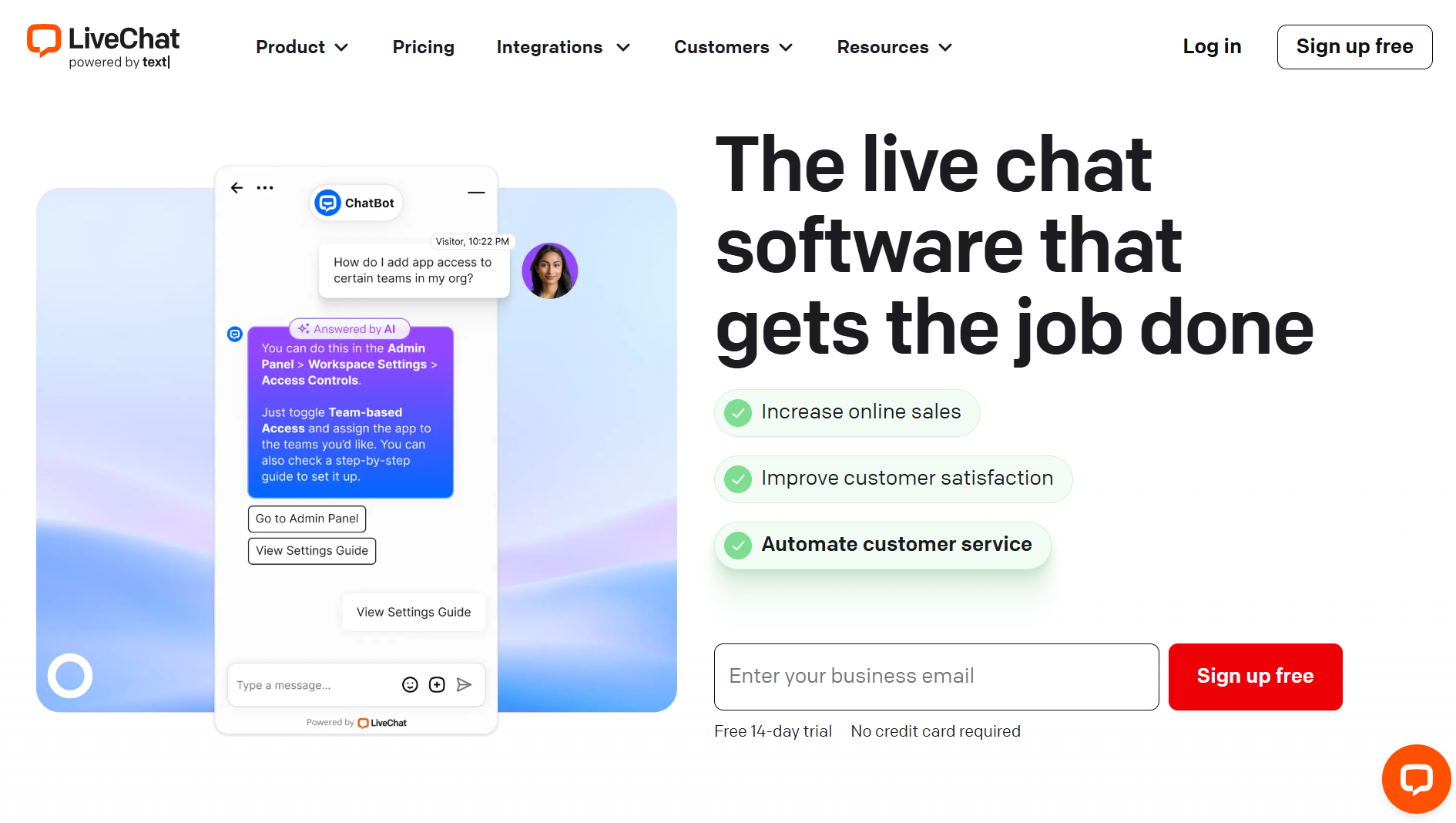
Live chat is a real-time messaging channel embedded directly into your website or app. Customers can start a conversation with your team — or an AI-powered bot — without leaving the page they're on or picking up the phone.
Modern live chat goes well beyond simple text exchanges. It integrates with your Customer Relationship Management (CRM) system, triggers proactive messages based on user behavior, and blends human agents with Artificial Intelligence to handle thousands of conversations simultaneously.
But the real value isn't the tool — it's what it enables: faster answers, less friction, and more moments where your business shows up exactly when a customer needs it.
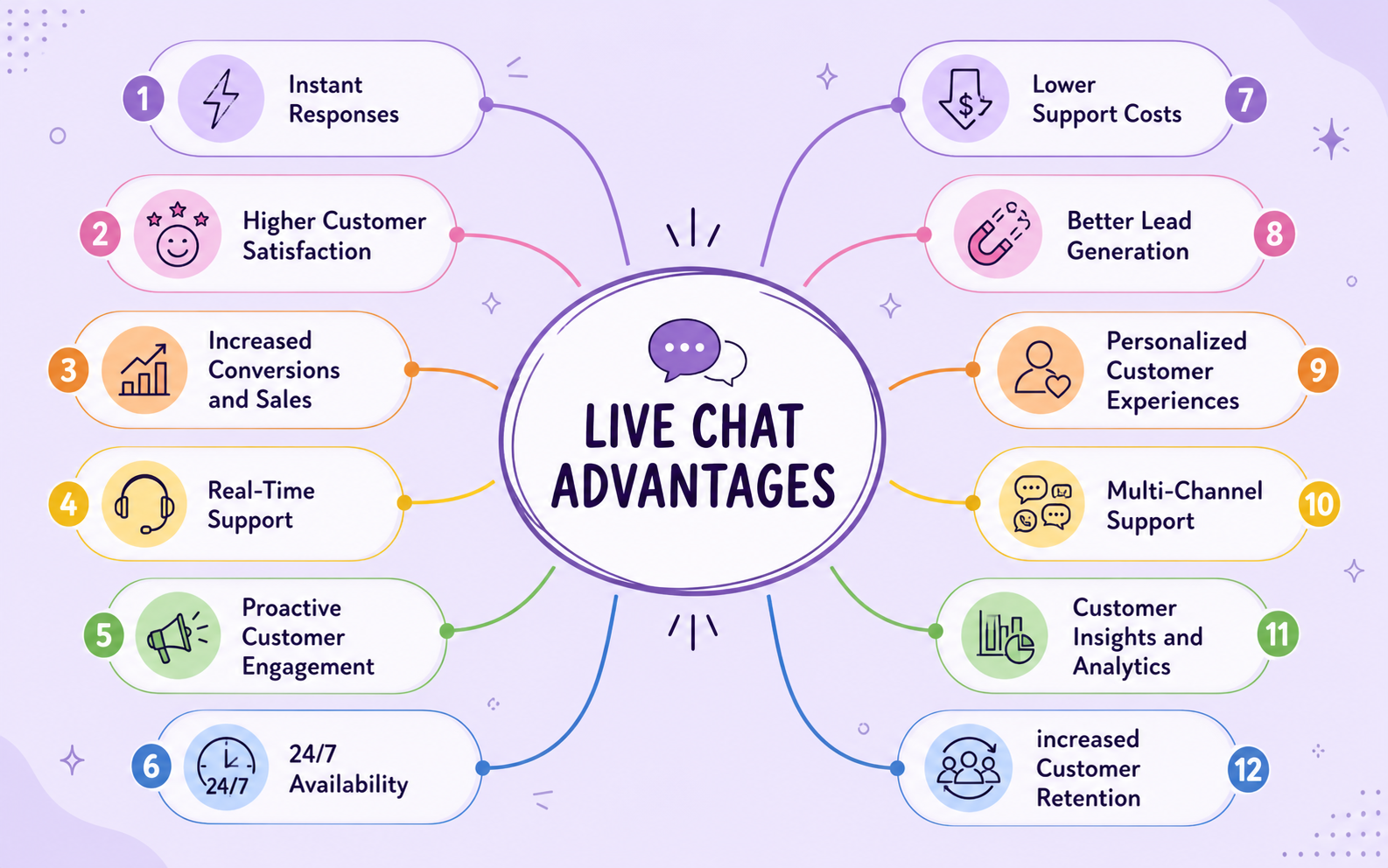
The 12 Key Live Chat Advantages
1. Instant Responses — Speed Is Everything
When someone is on your product page weighing their options, every second of silence is a reason to leave.
Live chat eliminates that dead air. Unlike email (average response time: hours) or phone (wait on hold, navigate a menu), live chat connects customers with answers in real time. Response times under one minute are the norm with a well-configured setup.
Speed isn't just a convenience — it's a conversion factor. The moment of intent is fragile. Live chat keeps users engaged at exactly the point they're most likely to act, whether they're on desktop or mid-session on mobile shopping.
2. Higher Customer Satisfaction
Live chat consistently scores higher on customer satisfaction than phone or email. Studies put live chat satisfaction rates at around 73%, compared to 61% for email and 44% for phone support. The reason is fairly straightforward: customers get help without interrupting their day. They don't have to switch tabs, call a number, or wait by their inbox. The answer comes to them, in context, where they already are.
This matters even more as mobile commerce grows. A customer browsing on their phone isn't going to call your support line. Live chat meets them where they are.
3. Increased Conversions and Sales
Research consistently shows that websites with live chat see conversion rates increase by up to 20%. The mechanism is simple: when someone hesitates at checkout or has a last-minute product question, a well-timed response removes the friction that would have otherwise killed the sale. This is conversion rate optimization in real time — no A/B test required, just a human (or AI agent) showing up at the right moment.
Think about it from the customer's side. They're comparing two products, unsure about sizing, shipping time, or return policy. Instead of hunting through your FAQ, they ask — and get an answer in 30 seconds. That's the difference between a completed purchase and an abandoned cart.
Real example: Intuit (the company behind QuickBooks and Mint) ran a controlled test placing live chat widgets at different points on their website. The results were hard to argue with: live chat drove a 190% increase in conversions on their lead generation landing page and a 211% increase in sales on product comparison pages. At checkout, average order value went up 43%.
4. Real-Time Support at Critical Moments
Not all website visits are equal. A user who has been on your pricing page for four minutes is fundamentally different from someone who just landed from Google.
Live chat lets you identify and engage high-intent visitors at the exact moment they're making a decision. Whether it's a first-time buyer hesitating over their cart or a returning customer trying to understand a subscription upgrade, real-time customer support catches them before they bounce — and before your competitor does.
Real example: When COVID-19 removed Adecco's ability to meet prospects face-to-face, they turned to live chat to maintain a personalized sales experience in a fully digital world. In the first two years, live chat-powered conversations generated over $57.7M in pipeline and $24.4M in closed revenue — a 46,000% ROI on the tool. The right conversation, at the right moment, with the right person changes the economics of sales entirely.
5. Proactive Customer Engagement
Most live chat implementations are reactive: the customer opens the chat, asks a question, gets an answer. That's fine. But the best implementations are proactive.
Trigger-based messaging lets you initiate customer engagement based on user behavior — someone spending five minutes on a pricing comparison, someone adding to cart and then sitting idle, someone returning to a product page for the third time. These signals are buying intent in disguise. It's how live chat starts to function less like support and more like a digital marketing channel with a direct line to revenue.
52% of customers are more likely to make a repeat purchase from a company that offers proactive chat. That's a retention lever most businesses aren't using.
Real example: Sam's Furniture combined analytics with live chat to trigger conversations when visitors spent significant time on specific pages. The result: approximately $50,000 in monthly sales revenue generated directly through live chat. The chat didn't interrupt every visitor — it targeted the ones who were clearly ready to buy but hadn't pulled the trigger.
6. 24/7 Availability — With AI and Automation
Your team can't be online around the clock. Your chat system can.
AI chatbots — increasingly powered by Generative AI and large language models — handle off-hours inquiries, answer FAQs, collect customer information, and escalate to human agents when needed. The result is an always-on customer support experience that doesn't require you to triple your team size.
For digital commerce in particular — where customers shop at midnight, on weekends, across time zones — this is a baseline expectation. And as social commerce on platforms like Instagram and TikTok Shop drives more impulse purchases at unpredictable hours, the 24/7 argument only gets stronger.
7. Lower Support Costs
One of the most practical live chat advantages is the economics.
A phone agent handles one call at a time. A live chat agent can handle three to five conversations simultaneously without a meaningful drop in quality. Layer in an AI agent for common queries, and you're deflecting a significant volume of tickets before they ever reach a human.
Businesses typically report support cost reductions of 15–30% after implementing live chat — not because they cut service quality, but because they stopped using an expensive channel for conversations that didn't require it.
Real example: Virgin Atlantic found that a single live chat agent could cover the work of approximately 15 agents handling emails and phone calls. That's not a marginal efficiency gain — it's a structural change in how support is resourced. The cost savings alone made the ROI case immediate.
8. Better Lead Generation
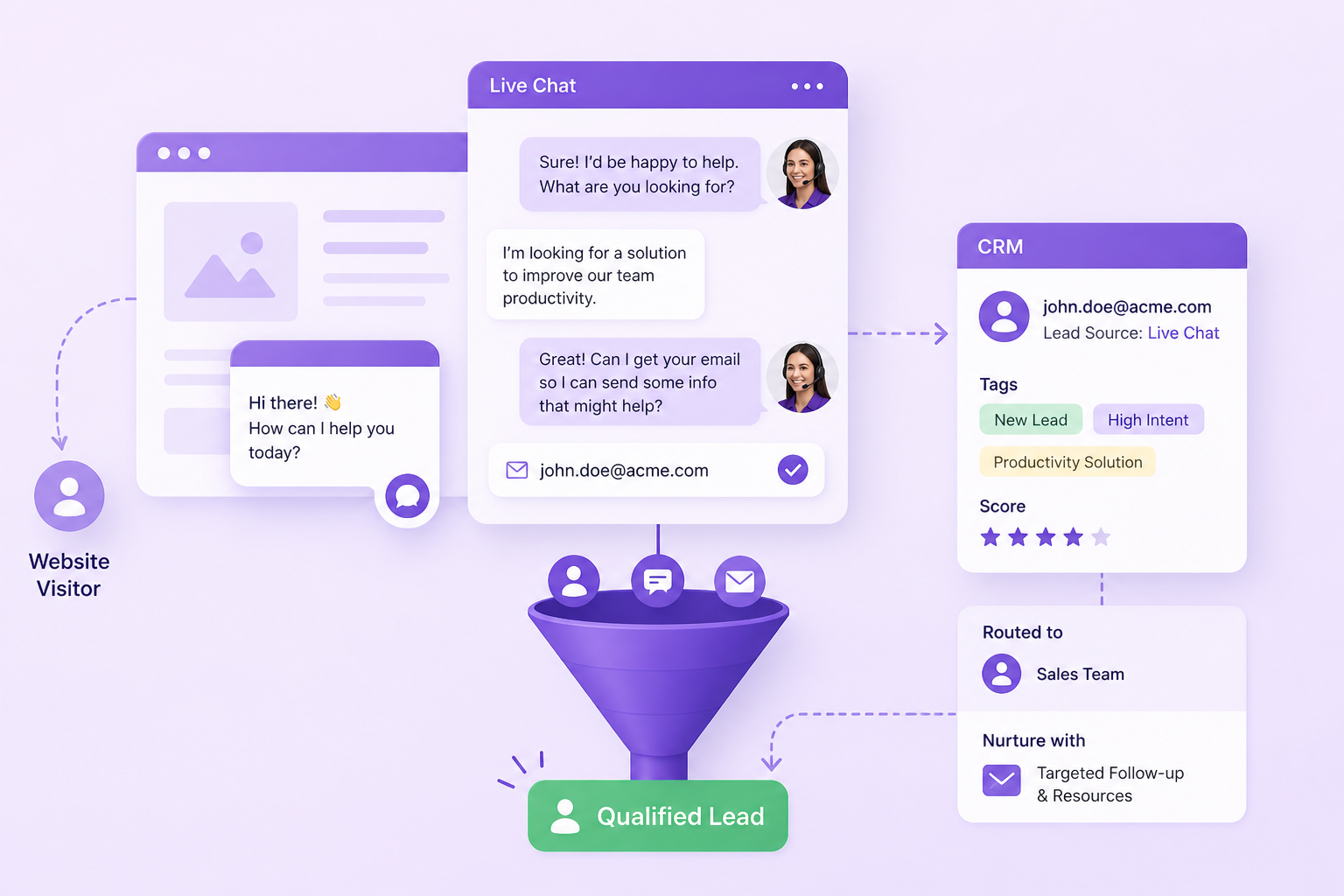
Live chat isn't just for existing customers. It's one of the most underrated lead generation tools available.
When a prospect visits your site, live chat gives you the opportunity to start a conversation, understand their intent, and collect contact information — in real time, while they're actively interested. That's a fundamentally different quality of lead than someone who fills out a form and waits for a follow-up. Combined with customer segmentation in your CRM, those chat-sourced leads can be routed, tagged, and nurtured far more precisely than anything coming through a static form.
9. Personalized Customer Experiences
Generic support feels "generic". Live chat — especially with CRM integration — lets you have context-aware conversations that actually reflect where someone is in their customer journey.
When an agent (or a well-configured AI agent) knows that this customer bought last month, had an issue with delivery, and is now looking at an upsell offer — the conversation changes completely. It goes from "How can I help?" to "I can see your order from March — are you looking to add to it?"
That kind of personalized experience isn't just good for satisfaction scores. It builds the kind of trust that drives repeat purchases and, over time, creates the same effect as well-designed loyalty programs — customers who feel known keep coming back.
10. Omnichannel and Multi-Channel Support
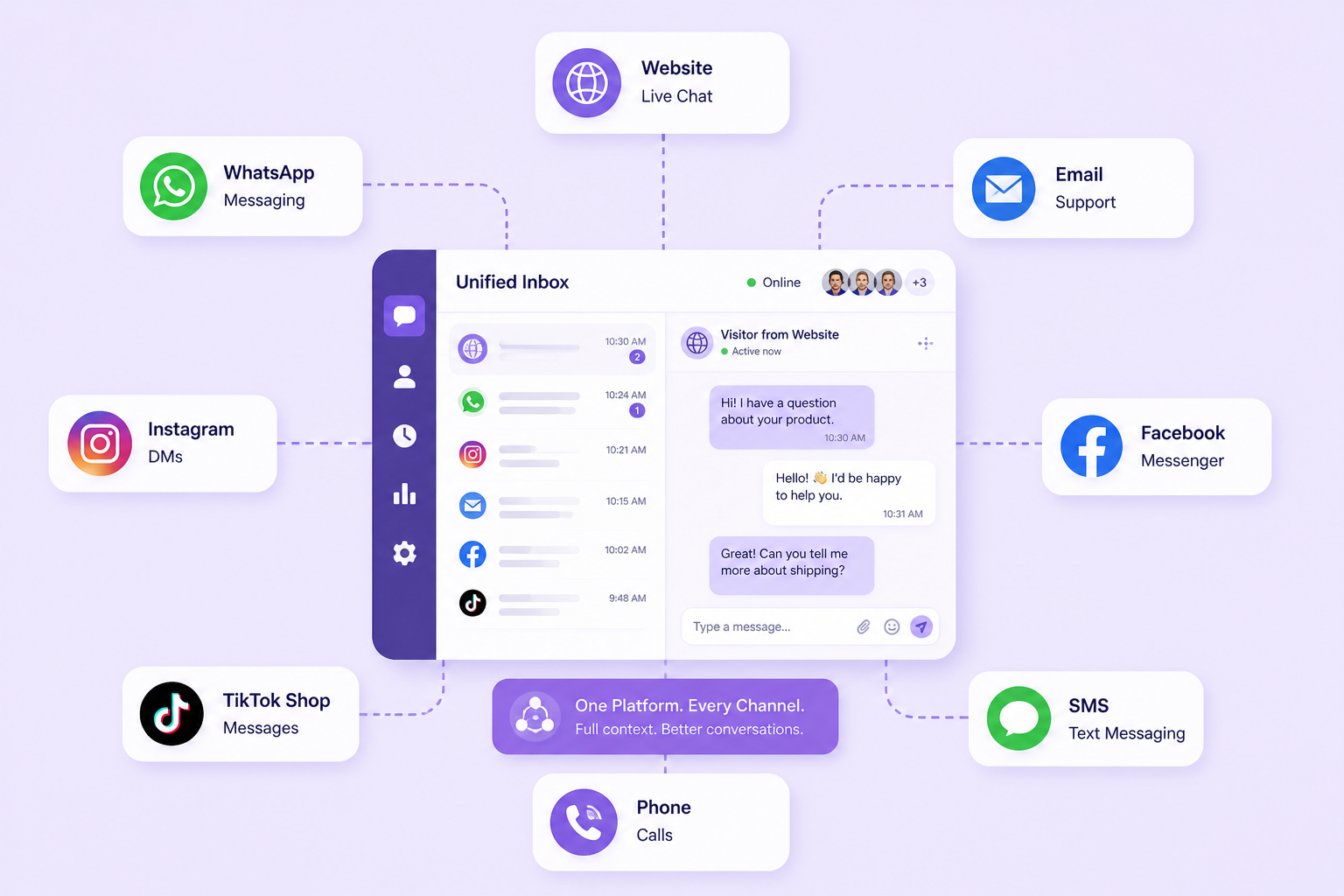
Modern customers don't stay in one place. They start a conversation on your website, continue it on WhatsApp, and might follow up via email. Live chat that operates in isolation loses that thread.
The best live chat tools are built for omnichannel retail — integrating with your CRM, email, social channels, and messaging apps to keep conversation history intact across every touchpoint. Add social commerce channels like Instagram DMs or TikTok Shop into the mix, and the ability to maintain that context becomes even more valuable. The customer doesn't have to repeat themselves. Your team doesn't have to guess what happened before. The whole interaction feels coherent — because it is.
11. Actionable Customer Insights and Analytics
Every live chat conversation is a data point.
Response time, resolution rate, CSAT score, most common questions, drop-off points in the conversation — all of this feeds directly into your customer insights. Over time, that data becomes one of the clearest feedback loops you have. Not "we think customers struggle with X" — but "here are 200 conversations in the last month where customers asked the same question and didn't find the answer in your docs."
That's how you improve product information, refine your content, and build better support — all at once. It's also how you start to understand full customer journeys rather than isolated interactions, which is what separates teams that improve systematically from ones that just react.
12. Increased Customer Retention and Loyalty
The long game of live chat isn't the first sale — it's the second, third, and fourth.
63% of customers say they are more likely to return to a website that offers live chat — not because live chat is a novelty, but because being helped quickly and effectively makes an impression. In a market where switching costs are low and attention is short, showing up at the right moment is how you build loyalty. It works alongside loyalty programs and post-purchase flows, reinforcing the relationship at every stage of the customer lifecycle.
Live chat is one of the most consistent ways to do that at scale.
Live Chat vs. Other Support Channels
Most businesses treat this as an either/or question. It isn't. But it's worth understanding where live chat actually wins.
| Channel | Speed | Personalization | Scalability | Cost |
|---|---|---|---|---|
| Live Chat | ⚡ Real-time | ✅ High (with CRM) | ✅ High (AI + agents) | 💚 Low–Medium |
| 🐢 Hours–days | 🔶 Medium | ✅ High | 💚 Low | |
| Phone | ✅ Real-time | ✅ High | ❌ Low (1:1 only) | 🔴 High |
| Chatbot-only | ⚡ Instant | ❌ Low | ✅ Very high | 💚 Very low |
Live chat gives you the speed of phone, the scalability of email, and the personalized experiences that chatbot-only solutions can't deliver. It's the best balance of all three — which is exactly why it's become the preferred channel for customers who actually know what their options are.
Where email fails: it's too slow for moments of purchase intent. Where phone fails: it's too expensive to scale and too demanding for customers. Where chatbot-only fails: it handles the simple stuff but falls apart on anything nuanced. Live chat, with human agents and Artificial Intelligence working together, fills all three gaps.
When Live Chat Works Best
Live chat isn't universally effective — context matters. Here's where it genuinely moves the needle:
E-commerce (product data questions, checkout): This is the highest-impact use case. A customer hesitating on a €150 purchase who gets a clear, fast answer about returns, payment options, or sizing almost always converts. Without that answer, they don't. This applies to traditional online stores or selling through social commerce channels.
SaaS onboarding: The drop-off point for most SaaS products is the first week. Live chat during onboarding — triggered when a user stalls on a key setup step — can dramatically improve activation rates.
Customer support escalation: When a chatbot hits its limit, the handoff to a live agent needs to be seamless. Live chat makes that transition invisible to the customer — no new ticket, no repeat explanation.
High-ticket purchases: The more expensive the decision, the more the customer wants to feel reassured by a human. Live chat bridges the gap between a digital browsing experience and the kind of confident conversation that closes deals. For businesses where customers can pay via digital wallets or multiple payment methods, chat is often the moment that makes someone comfortable enough to actually complete the transaction.
A word of caution: live chat done badly is worse than no chat at all. A widget that triggers every 10 seconds, offers a bot that can't actually help, and takes 15 minutes to reach a human — that's not live chat, that's friction with a friendly icon. Timing matters. Relevance matters. Having a real fallback to a human matters.
Common Mistakes to Avoid
Even good teams make these consistently:
Slow response times. If you advertise live chat but your average response time is 10+ minutes, you've negated the core advantage. Set real expectations and staff accordingly.
Overusing popups and triggers. Not every page visit needs a chat bubble appearing in the first three seconds. Over-triggering trains customers to close the chat before reading it.
No human fallback. Bots are great for 60–70% of queries. The remaining 30% need a real person. If there's no escalation path, customer frustration compounds.
Poor agent training. Live chat feels casual — and that's actually a strength. But agents who don't know the product, can't navigate the CRM, or give inconsistent answers erase the goodwill the speed created.
No analytics tracking. If you're not measuring CSAT, response time, and resolution rate, you're flying blind. The data is sitting there — use it to drive smarter decisions across your entire customer experience strategy.
Conclusion
Live chat delivers on speed, on conversion, on cost, and on the kind of customer experience that actually drives loyalty over time. But the businesses getting real results from it aren't treating it as a checkbox — they're treating it as a strategic channel.
The shift is in how you think about it. Live chat isn't a support feature. It's a growth channel — one that sits at the intersection of sales, service, and retention, operating in real time at every moment that matters across the full customer journey.
The brands winning on customer experience right now are the ones combining live chat with AI automation: handling volume at scale without losing the human touch that builds trust. Whether that's an AI agent fielding questions at 2am or a trained rep closing a high-value deal in real time, the infrastructure is the same.
If you're looking at how to improve your CX or scale your conversations without scaling your headcount, that's exactly the problem we built Amio to solve.
Table of Contents
Start building AI chatbots with Amio.
Book a 30-minute session where we will find out how AI bot can help you decrease call center costs, increase online conversion, and improve customer experience.
Book a demoWhat is Amio?
We understand your business on
Book a 30-min consultation session where we will discuss your support cost optimization potential, experience improvements, including our online conversion increase techniques
Request a demo