
Necessary cookies help make a website usable by enabling basic functions like page navigation and access to secure areas of the website. The website cannot function properly without these cookies.
Do Salesforce Chatbots Actually Work for E-Commerce?
If you’ve ever tried to understand Salesforce chatbots and ended up somewhere between Einstein Bots, Agentforce, Data Cloud and mild existential despair, welcome.
Salesforce has spent the last few years levelling up its chatbots and in 2025 they have finally evolved into AI agents that can automate customer service, boost call deflection and answer most of customer inquiries across webchat, WhatsApp and Facebook Messenger.
But there’s a twist. Different Salesforce chatbot tools behave very differently. And not all of them are actually built for e-commerce workflows like order tracking, returns or product recommendations.
In this guide, you’ll learn how Salesforce chatbots work, how Einstein Bots differ from Agentforce AI agents, where they shine in e-commerce, and when a third-party chatbot is the smarter choice.
New to AI chatbots? If you want a simple breakdown of how automation cuts support costs and boosts conversions, check out our practical guide with examples from real e-shops.
Table of Contents
- What is a Salesforce Chatbot?
- How Salesforce Chatbots Work (Explained Simply)
- Einstein Bots vs. Agentforce
- How Salesforce Chatbots Fit Into the Salesforce Ecosystem
- Key Benefits for E-Commerce
- Salesforce Chatbot Limitations
- When Third-Party Chatbots Perform Better
- Final Thoughts
- FAQ
Who This Article Is For
This guide was written for fast-moving e-commerce teams who want a clear, practical breakdown of Salesforce chatbots without the jargon and without the Salesforce marketing fog.
You’ll find this especially useful if you’re:
- an e-commerce brand running Service Cloud
- a retailer drowning in WISMO questions
- a support lead exploring AI automation
- a CTO comparing Salesforce chatbots vs. third-party chatbots
- a Shopify/Magento brand using Salesforce as your CRM backbone
If that’s you, you're in the right place.
What Is a Salesforce Chatbot?
A Salesforce chatbot is an automated assistant built inside the Salesforce ecosystem that helps businesses answer customer inquiries, deflect repetitive tickets, and deliver faster support across channels like webchat, WhatsApp, Facebook Messenger or in-app messaging.
There are two very different kinds of Salesforce chatbots. Einstein Bots handle simple, rule-based tasks like FAQs, form-filling or basic order checks. Think: “press 1 for this, press 2 for that,” but in chat form.
Agentforce, on the other hand, uses generative AI to act more like a real support agent. It understands natural language, pulls real-time data from Service Cloud, Data Cloud and your Knowledge Base, and can manage complex e-commerce conversations across webchat, WhatsApp and Facebook Messenger.
How Salesforce Chatbots Work (Explained Simply)
Most articles make Salesforce chatbots sound complicated. But at their core, they’re doing three simple things:
- Understanding what the customer wants (thanks to conversational AI + large language models)
- Fetching the right Salesforce data (Service Cloud, Knowledge Base, Data Cloud)
- Responding with the correct workflow or action (automated responses, case updates, order checks)
Let’s break this down in the clearest way possible.
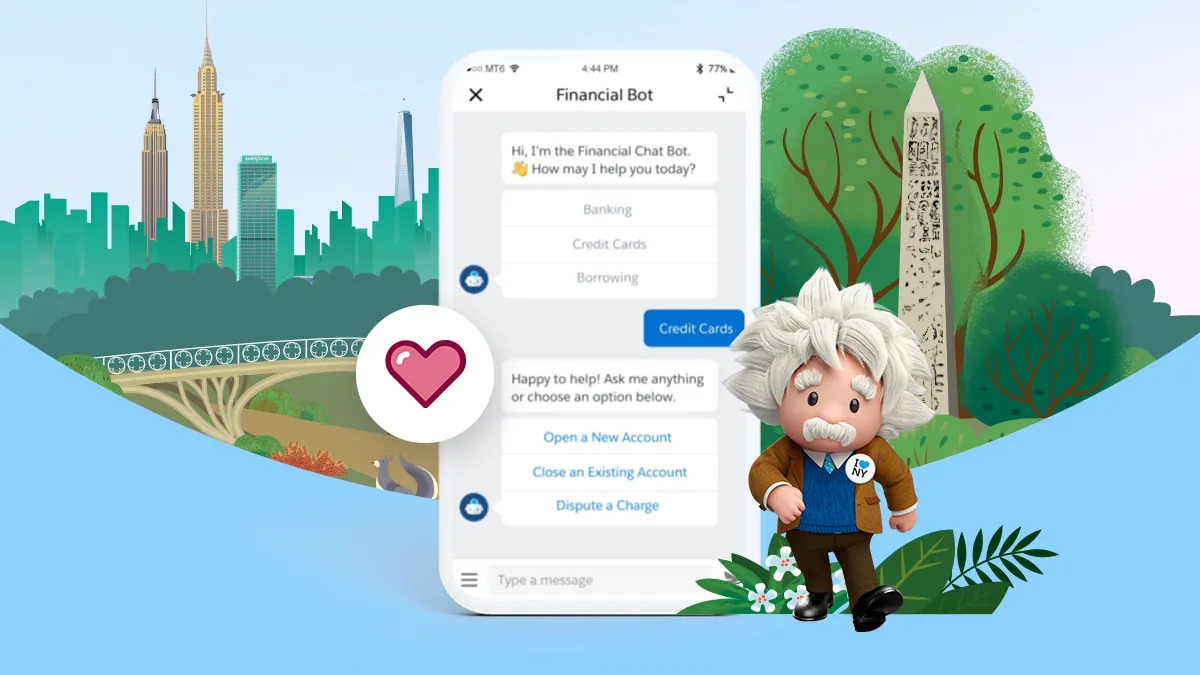
Einstein Bots: Rule-Based Automation Inside Service Cloud
Think of Einstein Bots as Salesforce’s “classic chatbot.” They work using:
- Flow Builder logic
- intents (what the customer is asking)
- dialogs (predefined steps)
- structured knowledge articles
Perfect for simple automation such as:
- answering FAQs
- checking an order status
- updating a field on a case
- collecting customer information
- routing a conversation to the right queue
But here’s the catch: rule-based means rigid. If the customer writes something unexpected (“my package ghosted me”), the bot can’t improvise. It follows the workflow, but nothing else.
Agentforce: AI Agents Powered by Generative AI
Agentforce is a completely different beast. Instead of following rigid flows, Agentforce uses:
- generative AI
- large language models
- real-time Salesforce data
- a low-code Agent Builder
This allows the chatbot to act more like a real human agent.
How Agentforce works
- It reads the customer message (natural language understanding).
- It checks Service Cloud cases, orders, returns, contacts, and past interactions.
- It consults your Knowledge Base for the official answer.
- It uses real-time Data Cloud context to personalize the response.
- It generates a natural, human-like reply, not a predefined script.
What this means for e-commerce
Agentforce can handle the messy, real-world scenarios Einstein Bots usually fail at:
- “My order says delivered but it’s not here.”
- “I want to return two items but keep the third.”
- “Do you have this product in size M?"
- “Is this device compatible with the model I bought last year?”
Instead of following a flow, the AI actually understands the situation and uses Salesforce data to answer accurately.
Einstein Bots vs Agentforce (Quick Overview)
| Einstein Bots | Agentforce AI Agents | |
|---|---|---|
| Core technology | Rule-based workflows | Generative AI + LLMs |
| Best for | Simple FAQs, intents, flows | Complex conversations, data-heavy tasks |
| Data source | Knowledge articles, predefined dialogs | Service Cloud, Data Cloud, Knowledge Base, real-time context |
| Channels | Webchat, Messaging | Webchat, WhatsApp, Messenger, SMS, In-App |
| Pros | Stable, predictable, easy for simple automation | More human-like, understands natural language, higher automation |
| Cons | Rigid, limited flexibility | Requires clean data + higher licensing costs |
| Ideal for e-commerce? | Only basic use cases | Stronger fit for WISMO, returns, order issues, recommendations |
How Salesforce Chatbots Fit Into the Salesforce Ecosystem
Salesforce chatbots don’t work in isolation. Their entire superpower comes from being deeply connected to the broader Salesforce ecosystem. Whether you’re using Einstein Bots or Agentforce AI agents, both types of chatbots can tap into the data, logic, and workflows that already live inside your Service Cloud, Data Cloud, and Knowledge Base.
Service Cloud as the Operational Brain
Service Cloud gives the chatbot direct access to real customer data like past cases, tickets, return requests, contact details, and even past shopping history.
- Einstein Bots use Service Cloud for basic tasks such as order status check, FAQs or routing.
- Agentforce, powered by generative AI, goes much further. It reads context, past interactions, customer profiles, and uses this knowledge to deliver relevant responses that feel closer to human customer support.
Knowledge Base as a Single Source of Truth
This is where structured, approved information such as articles, FAQs, troubleshooting workflows or policy explanations lives.
- Einstein Bots fetch predefined answers from the KB based on the dialog structure you set.
- Agentforce AI uses the Knowledge Base as a verified content source to ensure its generative AI responses stay accurate, consistent, and aligned with company guidelines.
Pro Tip: Your Knowledge Base is one of the most important parts of an AI strategy. If it's messy, automation fails. Read: What Every E-Shop Needs to Know About Customer Service Automation
Salesforce Data Cloud for Real-Time Customer Profiles
Data Cloud combines orders, interactions, preferences, product data, and marketing insights into one real-time customer profile.
- Einstein Bots typically don’t leverage Data Cloud.
- Agentforce uses Data Cloud to access real customer context, which is a huge advantage for e-commerce:
- personalised product recommendations
- more accurate WISMO responses
- faster return and exchange handling
The result? A chatbot that feels less like a widget and more like a virtual agent with full access to your customer data.
Key Benefits of Salesforce Chatbots for E-Commerce (With Real Use Cases)
If your e-shop runs on Salesforce, a Salesforce chatbot isn’t “just another chat widget.” It becomes a fully connected assistant that reduces customer support workload, boosts call deflection, and keeps response times fast across every channel.
Here are the benefits that matter most for e-commerce brands in 2025:
1. 24/7 Automation Without Hiring More Agents
Einstein Bots automate structured tasks like FAQs or simple order checks while Agentforce AI agents handle the messy, unpredictable questions humans usually get. Customers can check order status, shipping progress, delivery updates or delays directly in chat without waiting for a human agent.
Example:
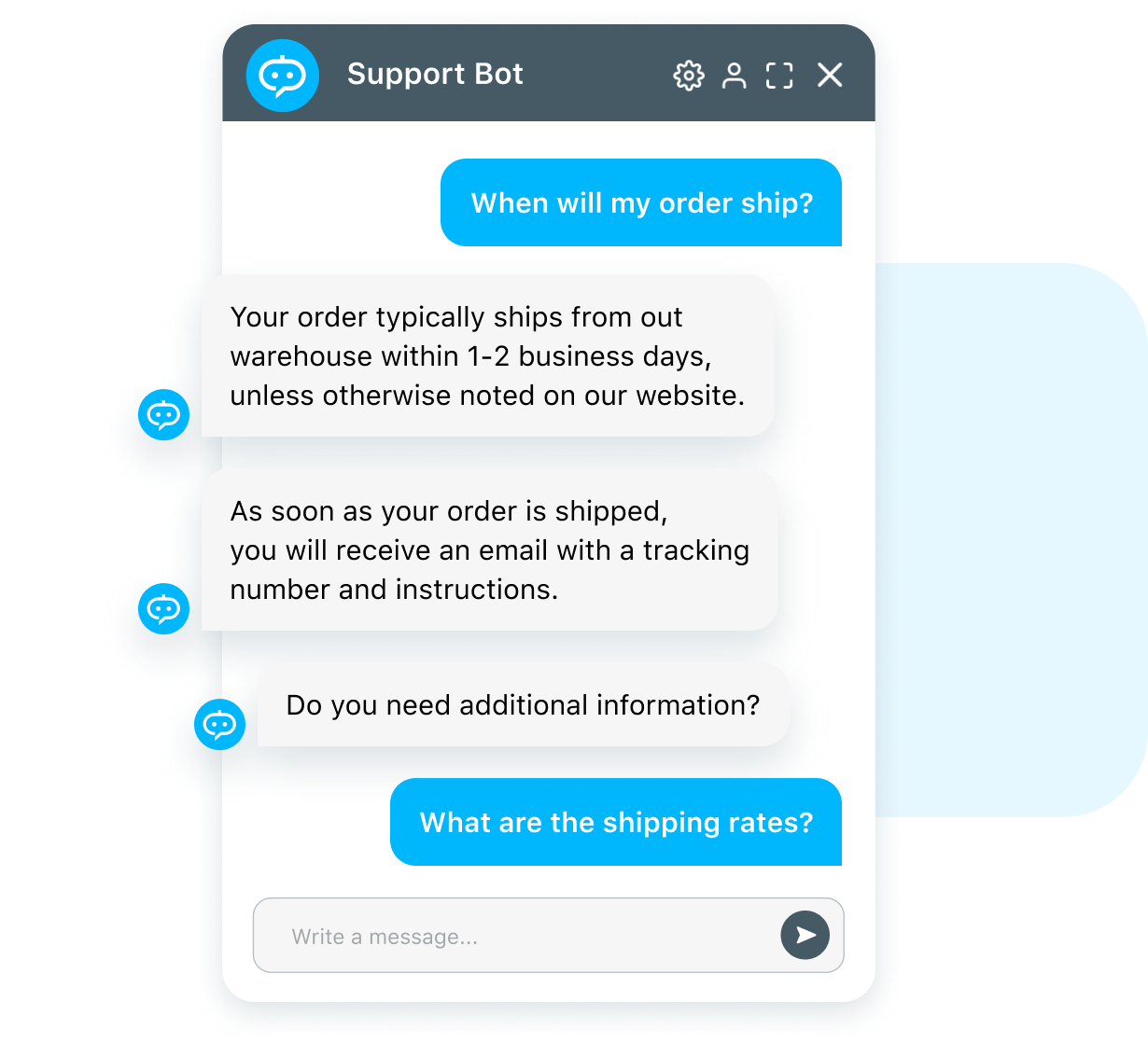
Customer asks: “Hey, where’s my package?” → Chatbot checks the order object in Service Cloud and returns exact carrier info, delivery date, tracking number.
2. 60–80% Deflection on Repetitive Requests
Because chatbots pull real order data from Service Cloud and approved answers from your Knowledge Base, they can resolve a large share of tickets instantly.
The more Salesforce data they access, the higher the deflection rate climbs.
Example:
Customer asks: “I want to return two of the three items.” → Agentforce understands the request and create or update a return case or even pre-fill fields using Data Cloud.
Thinking about ROI? This guide shows how to estimate time savings, cost reduction and automation ROI with real interactive calculator.
Salesforce Chatbot Limitations
At this point, you might be thinking: “Okay… Salesforce chatbots are powerful. But are they actually the best choice for an e-commerce brand like mine?”
Here’s the honest answer. Sometimes yes but very often, a third-party e-commerce chatbot is the better fit.
Even though Salesforce chatbots sound like they can do everything short of making you coffee, they do have limitations.
If you run a modern e-commerce brand with thousands of WISMO questions, dynamic inventory, seasonal drops, and messy customer messages… there are a few things you should realistically expect.
And yes, these are the things most articles politely avoid mentioning.
Let’s talk about them honestly and explain when a third-party e-commerce chatbot provider (like AMIO 👀) sometimes does the job better.
1. Rule-Based Logic Means Limited Flexibility
Einstein Bots are built on intents, flows, and dialogs. That’s perfect if your customers write like polite robots. But in real customer conversations? People write things like: “my package ghosted me” or “that return form bullied me into submission”
Rule-based AI doesn’t handle chaos well. It expects intents it already knows and dialogs you designed. Anything outside the script? It collapses like a soufflé.
Agentforce can handle it but only if all your product, order and return data lives perfectly inside Salesforce (which… for most brands, it doesn’t).
How third-party chatbots fix this
E-commerce-first bots like AMIO use generative AI + product data to understand:
- natural language
- half-written SKUs
- messy WISMO descriptions
- multi-item requests
- switching topics mid-sentence
Because they’re not tied to rigid flows, they understand the intent dynamically. So conversation with them feels like talking to a real human, not a flowchart.
2. Salesforce Chatbots Can’t Natively Read Your Product Feed
This is the limitation every online retailer encounters at some point.
Salesforce chatbots don’t automatically ingest product catalogs, variants, availability data, compatibility attributes, or promotions. Unless your entire product catalog is stored and perfectly maintained inside Salesforce, the chatbot has no way to answer most of the pre-purchase questions such as:
- “Do you have this in size M?”
- “What’s similar to this model?”
And the reason is simple. Salesforce chatbots were built for support tasks, not product-driven conversations. Most stores keep product data in Shopify, Magento, or other systems. And, unless you build a custom integration, Salesforce generative AI is not fully tied to these product data.
How third-party chatbots fix this
Third-party e-commerce chatbots reverse this entirely. They treat the product feed as their primary knowledge source. This means they can perform:
- instant product recommendations
- FAQ answers based on real product attributes
- conversational product search
- sizing, style, compatibility, and availability answers
This is why they can act like actual shopping assistants, something no native Salesforce bot can do without heavy custom engineering.
Your product feed is your superpower. Here’s how top e-shops use AI for product search, variants, recommendations and compatibility answers.
3. Salesforce Chatbot Implementations Take Time
Building a Salesforce chatbot is not a weekend DIY project. Launching a Salesforce chatbot means configuring Flow Builder logic, designing intents, mapping Knowledge Base articles, setting up case routing, connecting channels and passing internal security checks.
If your team doesn’t live inside Salesforce every day, this setup feels like assembling IKEA furniture without the little man on the instructions.
And when you add multichannel support (WhatsApp, webchat, Facebook Messenger), things get complex very fast.
How third-party chatbots fix this
E-commerce-focused providers approach this differently.
They offer prebuilt workflows for WISMO automation, returns, exchanges, and refund eligibility. They support WhatsApp, Instagram and Messenger immediately, and they integrate with your catalog out-of-the-box. The setup becomes a matter of days, not a multi-phase Salesforce project.
Speed matters and this is where third-party solutions consistently outperform.
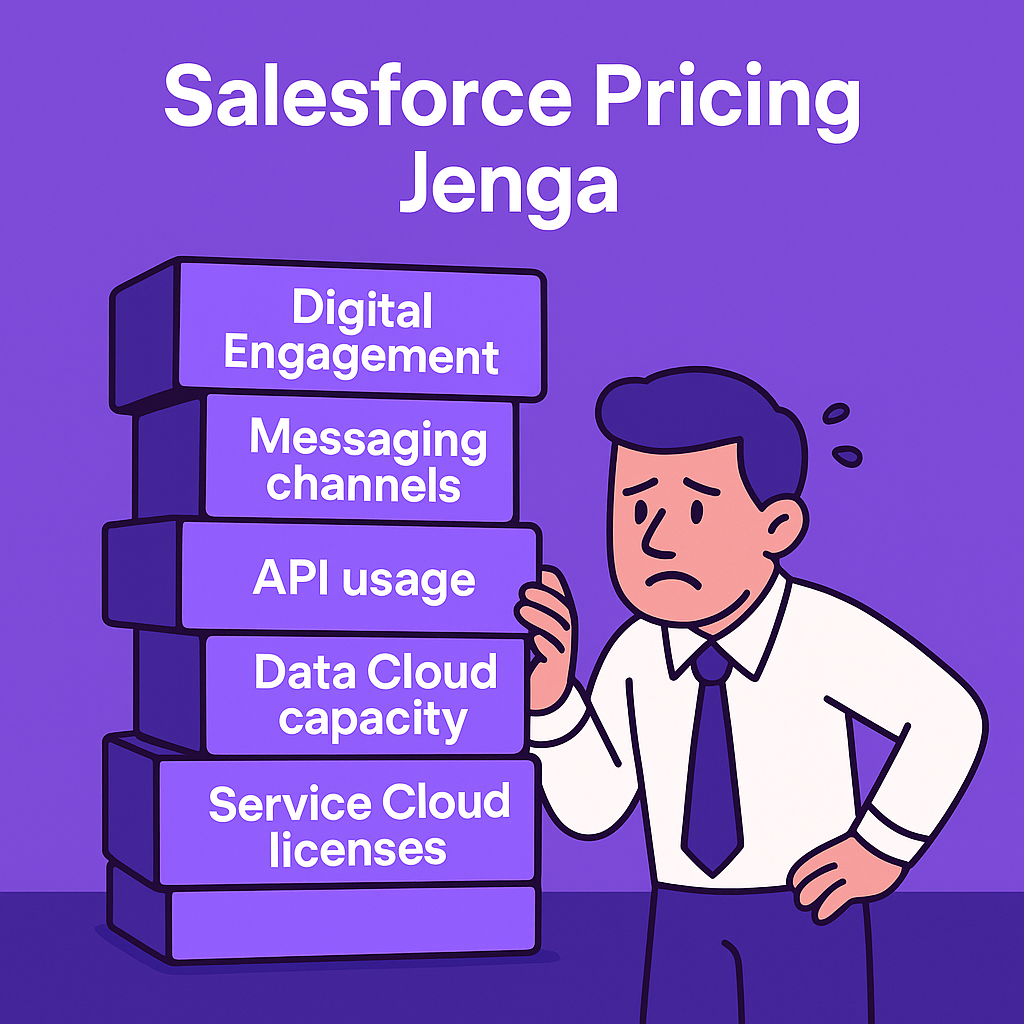
4. Pricing Scales Quickly When You Add Channels
Salesforce’s pricing model is logical for enterprise support, but not always ideal for high-volume retail. You pay for:
- Digital Engagement
- Messaging channels
- API usage
- Agentforce AI usage
- Data Cloud capacity
- Service Cloud licenses
The more your customer volume grows, the harder it becomes to predict your monthly cost.
How third-party chatbots fix this
Third-party e-commerce chatbot providers usually offer simpler, more predictable pricing. Most include all channels (webchat, WhatsApp, Instagram, Messenger) in a single plan, and costs scale with conversation volume rather than with technical add-ons. For many retail teams, this makes budgeting far easier..
Third-party chatbots often offer flat, predictable pricing. Salesforce? More like a menu where everything is à la carte.
When a Third-Party E-Commerce Chatbots Perform Better
If your product data lives in Shopify, Magento, WooCommerce, or another PIM…
If you have seasonal drops, hundreds of SKUs, or thousands of WISMO requests…
If your customers want product recommendations inside Instagram DMs or WhatsApp…
Then Salesforce chatbots give you only part of what you need.
You still lack:
- instant product-search answers
- automated returns/exchanges
- conversational product recommendations
- real-time stock checks
- plug-and-play product feed ingestion
This is where most e-commerce teams hit the limits of the Salesforce ecosystem.
| Capability | Einstein Bots (Rule-Based) | Agentforce AI Agents (Salesforce AI Chatbot) | Third-Party E-Commerce Chatbot (AMIO, etc.) |
|---|---|---|---|
| Best Use Case | Simple FAQs, structured flows, basic customer support | Complex conversations, data-driven support inside Salesforce | E-commerce automation, product-driven conversations, multichannel commerce |
| E-Commerce Depth | Low – handles only predictable flows | Medium – handles messy conversations, but only if all data lives in Salesforce | High – built specifically for order issues, recommendations, returns & exchanges |
| Product Feed Ingestion | No native support | Only with custom integrations + perfect Salesforce catalog | Yes – direct Shopify/Magento/PIM feed ingestion out-of-the-box |
| WISMO Automation | Basic order status from Service Cloud | Advanced WISMO if data is clean in Service Cloud + Data Cloud | Instant WISMO via carrier API, tracking data, and real-time order sync |
| Returns & Exchanges | Only simple scripted flows | Works only if return logic lives in Salesforce | Full workflows: multi-item returns, exchanges, eligibility checks |
| Product Recommendations | No | Only if catalog is stored in Salesforce | Yes – AI recommendations based on feed attributes, variants & behavior |
| Setup Speed | Medium – requires Flow Builder & KB configuration | Slow – requires data auditing, LLM setup, Data Cloud | Fast – ready-made retail workflows, launch in days |
| Pricing Predictability | Medium – depends on plans & Digital Engagement | Low – costs grow with API usage + AI credits + Data Cloud | High – flat pricing or volume-based, all channels included |
| Channel Coverage | Webchat + some messaging | Webchat, WhatsApp, Messenger, SMS (each add-on) | Full omnichannel: WhatsApp, Instagram, Messenger, webchat, email |
| Integration Flexibility | Strong via AppExchange apps | Strong inside Salesforce ecosystem | Strong external integrations (Shopify, Magento, ERP, PIM, carriers) |
| Best Fit For | Companies with predictable support needs | Large orgs with clean Salesforce data & complex workflows | Fast-moving e-commerce brands with dynamic catalogs & high WISMO volume |
Where Einstein Bots Make Sense
Einstein Bots are a good fit when:
- your use cases are predictable,
- you need stable rule-based flows,
- your team wants simple automation inside Service Cloud.
They’re steady, reliable, and great for “press-1-for-this”-style tasks.
When Agentforce Is The Right Tool
Agentforce AI agents work best when:
- all your support data lives inside Salesforce,
- your team has a clean Knowledge Base and unified customer records,
- you want generative AI deeply tied to Service Cloud and Data Cloud.
If your Salesforce ecosystem is mature, Agentforce shines.
When Third-Party Chatbots Outperform Salesforce
Third-party e-commerce chatbots are ideal when:
- your product data lives in Shopify, Magento, WooCommerce or a PIM,
- customers ask for sizing, compatibility or product alternatives,
- you need fast WISMO automation across WhatsApp, Instagram and Messenger,
- you want fast setup, lower cost and omnichannel coverage without add-ons.
They bring shopping-assistant superpowers that Salesforce doesn’t offer natively.
Want to know how much time your support team could save? Try our AI Automation ROI Calculator
Why AMIO Fits This Category Perfectly
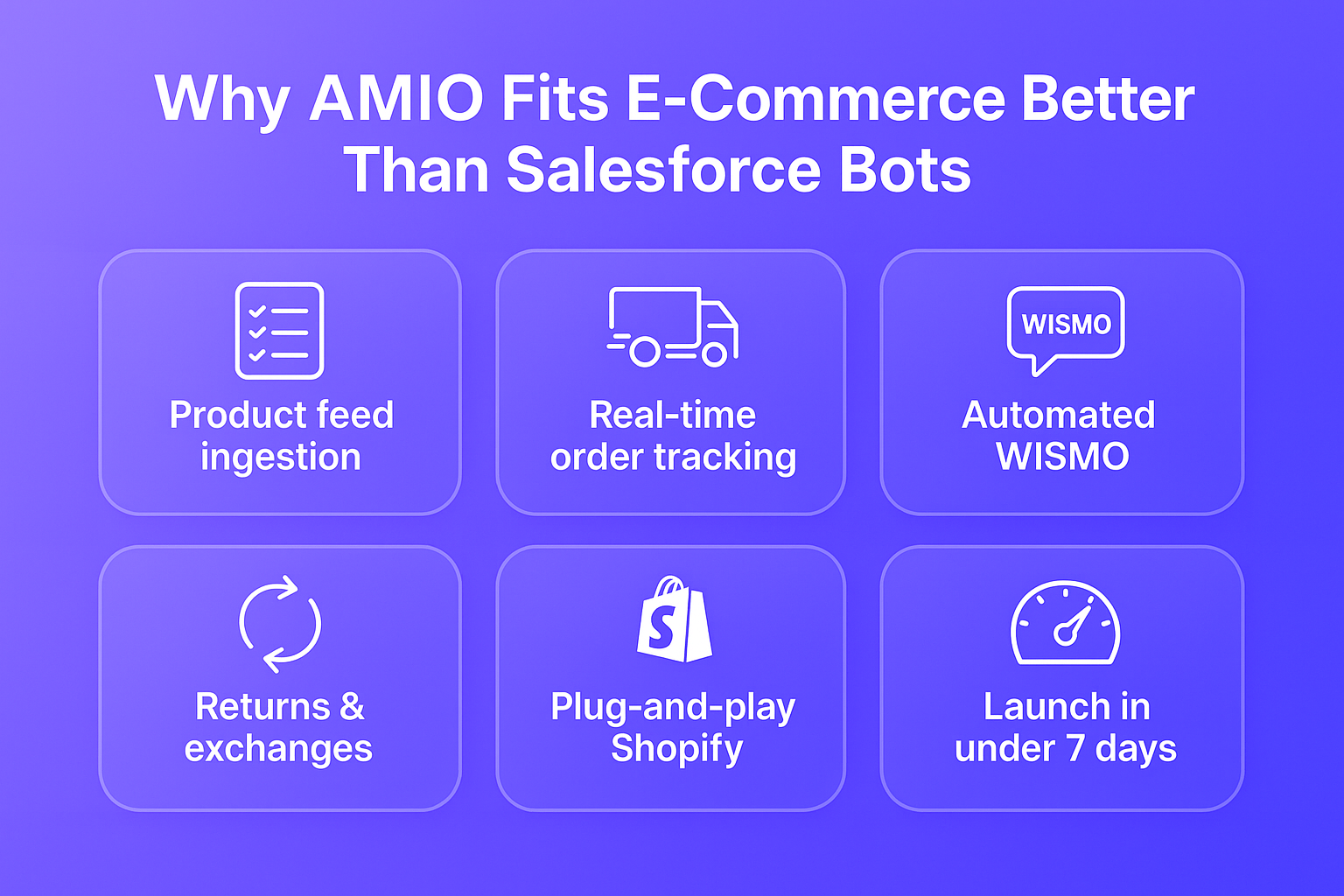
AMIO is not a generic chatbot platform. It distinguishes itself by being purpose-built
specifically for e-commerce automation, with features Salesforce bots simply don’t have:
- native ingestion of product feeds without transformation or mapping
- real-time order tracking
- automated WISMO flows
- predictable, contract-friendly pricing
- returns & exchanges
- plug-and-play Shopify and helpdesk integrations
- launch in under 7 days
For brands running on Salesforce, AMIO becomes the perfect complement. Salesforce maintains the customer profile, historical context and CRM logic. AMIO handles everything that’s uniquely e-commerce - product discovery, order issues, returns, recommendations and the messy conversations between.
Together, they deliver the modern support experience retailers actually need.
👉 See how AMIO automates returns, WISMO and recommendations in under 7 days. Try the Live Demo →
Final Verdict: Salesforce vs Third-Party Chatbots
If you made it this far, congratulations. You now understand Salesforce chatbots better than 99% of the internet. And hopefully, the picture is clear. Salesforce Einstein Bots and Agentforce are powerful tools, especially when your workflows, customer data and service processes already live inside the Salesforce ecosystem.
But e-commerce has its own rules.
Customers ask for product recommendations, variants, compatibility questions, promo availability, delivery status, returns and exchanges all in the same conversation. That’s where native Salesforce chatbots often stop short and where a dedicated e-commerce chatbot provider becomes the smarter choice.
In many cases, the winning strategy isn’t choosing between a Salesforce chatbot and a third-party ecommerce chatbot. It’s combining them.
Salesforce handles the CRM backbone. Third-party chatbots handle the product feed, WISMO, and the shopping experience.
And AMIO... Well, that’s the tool that ties the two worlds together without the complexity.
So if your goal is fast automation, happier customers, fewer repetitive tickets and a support team that stops drowning in WISMO, you now know exactly where to look.
FAQ Section
What is a Salesforce chatbot?
A Salesforce chatbot is an automated virtual assistant built inside the Salesforce ecosystem. It uses Conversational AI, natural language understanding, and company Customer data to answer customer inquiries, automate support tickets, and improve the overall customer experience. Depending on the setup, it can be a rule-based Einstein Bot or a generative AI-powered Agentforce AI agent.
Does Salesforce have an AI chatbot?
Yes. Salesforce offers Agentforce, an AI chatbot powered by generative AI, large language models, and real-time context from Service Cloud and Data Cloud. It goes beyond rule-based intents and delivers more human-like, context-aware automated responses.
What is an Einstein Bot?
Einstein Bots are Salesforce’s classic rule-based AI chatbots. They rely on intents, dialogs, and Flow Builder logic to handle predictable tasks like FAQs, order statuses, and simple customer journeys. They work well for structured processes but can struggle with messy human conversation.
What is Agentforce?
Agentforce is Salesforce’s new generation of AI agents. It uses large language models, Knowledge Base articles, Salesforce data, and machine learning to interpret complex customer inquiries, pull accurate information from Service Cloud, and respond naturally across channels like Facebook Messenger, webchat, SMS, and in-app messaging.
Is Salesforce chatbot free?
No. Salesforce chatbots require paid components such as Service Cloud licenses, Digital Engagement, messaging channels (WhatsApp, SMS, Messenger), and Agentforce AI usage credits. Total cost varies depending on volume, channels, and workflow deployment.
How do I create a chatbot in Salesforce?
You build one using Einstein Bot Builder or the low-code Agent Builder. This typically includes:
– intent training
– mapping knowledge articles
– bot content creation
– data integration
– Service Cloud case routing
– multichannel support setup (webchat, SMS text messaging, Messaging for In-App and Web)
Most companies also connect the chatbot with their Knowledge management system, CRM systems, and customer journeys inside Service Cloud.
Are Salesforce chatbots good for e-commerce?
They’re strong at support automation, checking order statuses, routing support tickets, pulling customer profiles, and improving operational efficiency.
However, they don’t natively ingest product feeds, manage multi-item returns, or provide conversational product search. For these tasks, many retailers use a third-party e-commerce chatbot provider for deeper automation.
Salesforce chatbot vs. third-party chatbot. What’s the difference?
Salesforce chatbots excel at CRM-driven workflows, case management, and Omnichannel Routing inside the Salesforce ecosystem.
A third-party ecommerce chatbot focuses on product data, WISMO automation, recommendations, variant checks, and real-time catalog searches. They act more like a shopping assistant, especially in channels like WhatsApp, Instagram, and webchat.
Which channels does Salesforce chatbot support?
Salesforce supports webchat, Facebook Messenger, 360 SMS, SMS text messaging, and Messaging for In-App and Web. WhatsApp and Instagram are available through Digital Engagement, though configuration is more complex than plug-and-play chatbot platforms.
How much does Salesforce chatbot cost?
Costs vary widely. You typically pay for:
– Service Cloud License
– Digital Engagement
– messaging channels (WhatsApp, Messenger, SMS)
– AI usage credits
– Data Cloud storage
– API calls
Because each layer adds cost, many e-commerce brands choose a third-party chatbot provider for more predictable pricing.
Table of Contents
Start building AI chatbots with Amio.
Book a 30-minute session where we will find out how AI bot can help you decrease call center costs, increase online conversion, and improve customer experience.
Book a demoWhat is Amio?
We understand your business on
Book a 30-min consultation session where we will discuss your support cost optimization potential, experience improvements, including our online conversion increase techniques
Request a demo